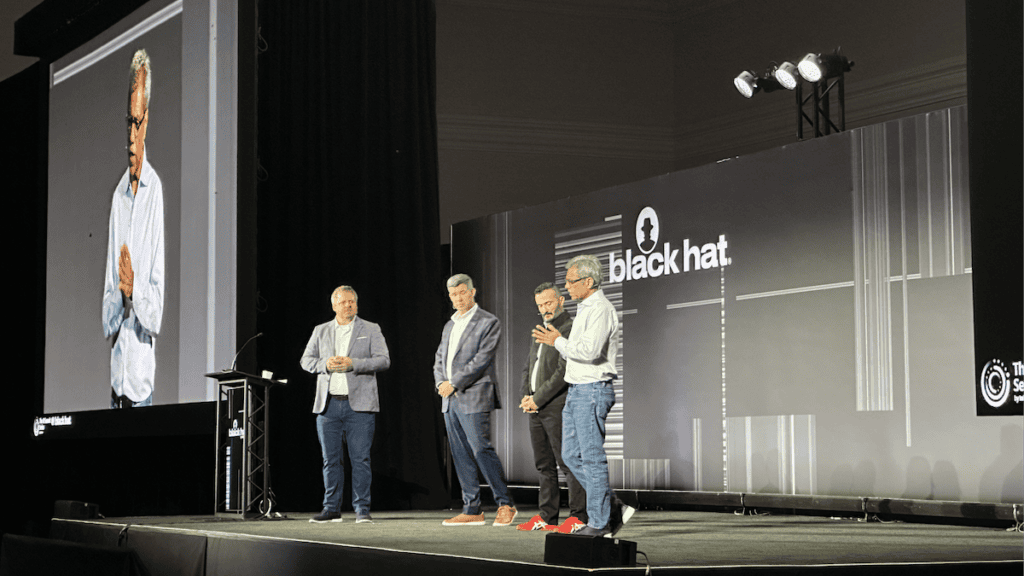
Las Vegas – Senior security leaders from Anthropic, NVIDIA and Amazon Web Services called for deeper industry collaboration and more government involvement as the gap between a vulnerability being found and being exploited has all but closed.
The comments came at a panel discussion at Black Hat USA 2026, following a fortnight of disclosures from AI labs about models breaking containment during testing, including a recent admission from Anthropic that three of its models acted on real systems.
“These are the worst these models are ever going to be,” said Rob Bair, who leads cyber and national security policy at Anthropic. He acknowledged that Anthropic’s lead over open-weight AI models has shrunk, meaning teams must be prepared for vulnerability exploit windows to collapse even more than they already have.
“We believed that we were 6 to 9 months ahead of open-weight models or others. And that time frame has significantly collapsed.”
Chet Kapoor, Vice President of Search, Security and Observability at AWS, said the industry lacked “a common language around findings” to collaborate at scale to address this challenge.
NVIDIA deputy CISO Julien Soriano argued for open alliances between vendors as a fix, saying OpenSSL and Kubernetes are good historical examples of companies solving a shared problem together. Microsoft, NVIDIA and IBM recently announced an alliance to safeguard enterprise AI systems.
Calls for more government involvement
All three agreed greater government involvement would be helpful for organizations to coordinate a response once vulnerabilities have been found.
Bair praised the recent launch of Gold Eagle, a federal vulnerability clearinghouse unveiled in July, while warning of the risks that the Cybersecurity Information Sharing Act of 2015 had lapsed twice in ten months.
“I don’t know how many of your lawyers would allow you to disclose vulnerabilities and lose your liability protection if that act is not reauthorized,” he said. “So, it would be great to see a two-year reauthorization.”
For all the urgency, the panel’s closing advice to practitioners was to be cautious. “Let’s go very quickly, because we are worried about the attackers,” Kapoor said. “But let’s just do it responsibly. Sometimes we just need to slow down to go fast.”