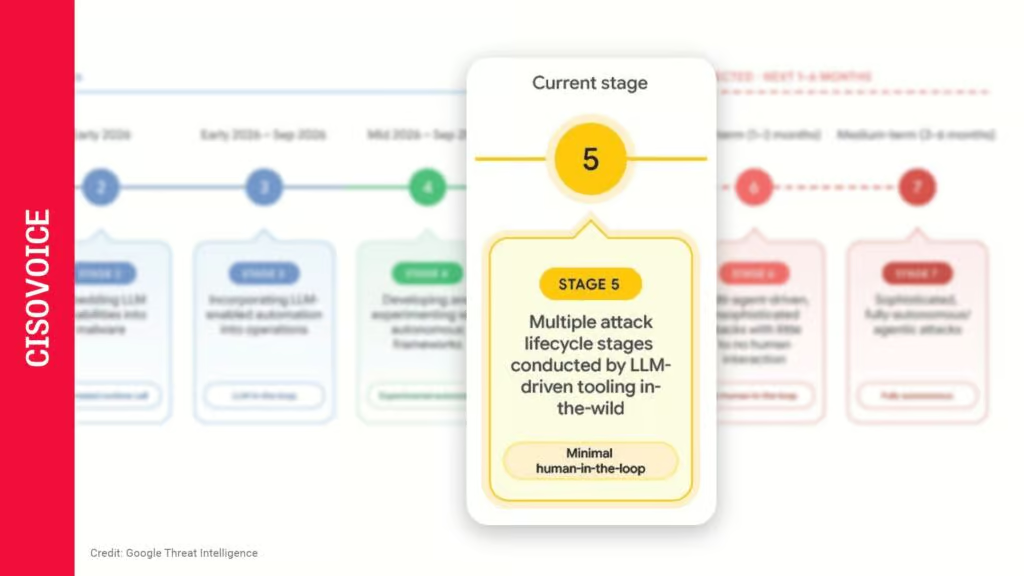
An unidentified Chinese-speaking threat group used the open-source autonomous AI penetration-testing framework Cairn to discover and exploit a zero-day.
Amazon Threat Intelligence said in a Nov. 20 blog post that it uncovered the group’s activities in September after the hackers left a publicly hosted instance of Cairn running without authentication, allowing anyone online to see its operational history.
Based on an analysis of the group’s project configurations, actor prompts, and AI output, Amazon researchers uncovered that the hackers gave the AI framework a list of targeted IP addresses with the goal of obtaining “shell access.”
“Based on those inputs, the AI agents planned, executed, and adjusted their approach as they learned, without the operator choosing each next step,” said CJ Moses, CISO of Amazon Integrated Security.
Amazon attributed the activities to a Chinese-nexus group with moderate confidence, based on the attackers’ use of Simplified Chinese in their prompts, as well as script execution timestamps that aligned with China Standard Time and the targeting of universities likely of strategic interest to China.
Last week, Amazon disclosed a similar campaign tied to disparate Chinese-nexus groups that used ARTEX, an AI penetration testing tool.
Zero-day exploit
The AI agents discovered and exploited a path traversal zero-day in the open-source medical imaging AI application MONAI Label. The flaw, which impacts MONAI Label datastore upload endpoints, allows arbitrary file writes. The project’s maintainers merged a fix for the flaw on Oct. 19 after being alerted by Amazon.
Amazon said the hackers used the Cairn autonomous framework to map MONAI Label API endpoints, find an upload endpoint’s filename parameter, and test its path traversal to check whether the endpoint was vulnerable, as well as write files to the server in a span of 11 minutes.
“In a later session, the agents used the same vulnerability to write a Python reverse shell payload to sitecustomize.py, a file Python automatically imports at interpreter startup,” Amazon said. “The agents then triggered a training API endpoint to spawn a new Python process. The new process imported the payload and established a reverse shell running as root.”
Amazon inferred that the hackers then used the zero-day to tunnel into a university network. In another case, the agents spent more than six hours testing over 30,000 credential combinations against a university GPU server and other systems on the same network, without finding a working login.