A new extortion brand going by the name Inception has claimed responsibility for seven breaches a mere week after making its presence known, with names like AMD and PepsiCo supposedly penetrated by the gang. And according to cybersecurity researchers at Okta, Inception is very likely the new home of a cluster once tied to a far more well-known threat actor: ShinyHunters.
In a new report, published Nov. 23, Okta observed numerous overlaps that led it to conclude that a cluster it tracks had “very likely” changed its brand affiliation. That said, Okta has not been able to independently confirm any of the leaks claimed by the leak site.
The attacker has used a familiar set of tactics throughout its existence, Okta said. That includes targeting several sectors — such as financial firms or healthcare operators — and registering web domains intended to trick their victims.
The hackers then attempt to use voice phishing (known as vishing) to pose as the employer’s support department and con victims into urgently resetting their passwords using the aforementioned domain names, thereby giving the threat actor access to SaaS applications from which data can be stolen. The pilfered data is then often used to extort victims under threat of publication on a leak site.
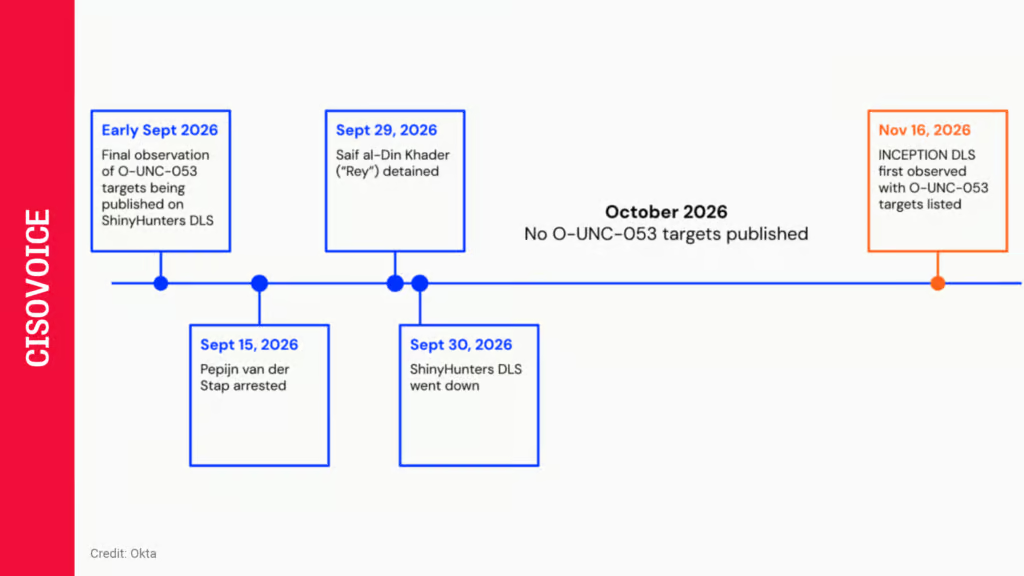
Okta has been tracking the group using the name O-UNC-053. From March to September 2026, Okta said it “regularly observed organizations targeted by O-UNC-053 infrastructure appearing on the ShinyHunters DLS [data leak site].”
After ShinyHunters claimed to have hacked an FBI jobs website and several of its alleged members and affiliates were arrested in September and October, O-UNC-053 targets stopped appearing on the ShinyHunters DLS and later turned up on the new Inception domain.
However, Okta said that this does not necessarily mean that O-UNC-053 and ShinyHunters are the same group. For example, ShinyHunters’ DLS listed organizations that O-UNC-053’s infrastructure had not targeted, Okta said. Even so, the company described a “significant relationship between the two entities.”
Okta recommends that organizations adopt account security measures such as passkeys and smart cards, train employees in how to identify suspicious emails and social engineering techniques, limit access to sensitive applications to managed devices, and actively monitor for any company systems that are communicating with suspicious domains.