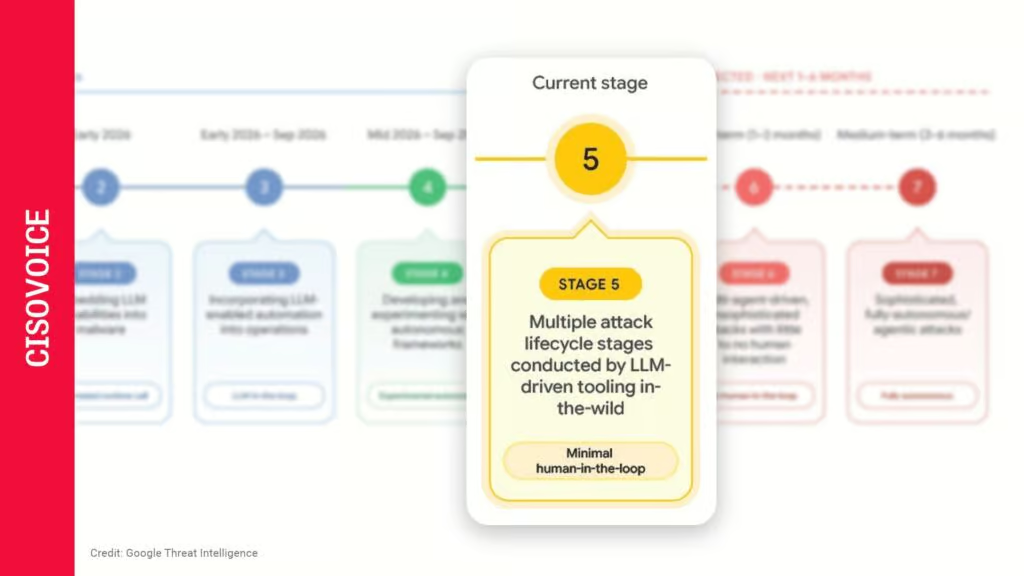

Google Threat Intelligence Group (GTIG) has released a new report warning that “forward leaning adversaries” have been improving their AI abilities and utilizing artificial intelligence in more advanced ways than previously seen. This has led to threat actors moving from “basic prompting to agentic AI workflows and AI-enabled automation.”
Now, adversarial groups are upgrading their workflows with the help of AI, the report stated, “creating highly autonomous systems capable of reasoning through complex tasks and making dynamic decisions without the need for human oversight.” That includes vulnerability reconnaissance, leaked credential management dashboards, automated pentesting frameworks and active target exploitation.
The result has been a dramatic increase in speed and efficiency on the part of the hackers. For example, Google explained that it had observed hackers “compromise a cloud resource, then plan, build, and execute an agent-enabled mass credential harvesting campaign in under six hours.”
Not only that, but Google advised that the larger role of AI means companies are at greater risk than before, with enterprise AI assets increasingly finding themselves in the hackers’ crosshairs. GTIG found adversaries targeting proprietary AI models and source code, API credentials and cloud environments, all in service of sustaining unauthorized AI workloads.
AI is being used across the attack landscape, from reconnaissance and phishing lure creation to malware obfuscation and troubleshooting after the fact. Information operations campaigns can also be more efficiently scaled using AI.
Affected sectors include healthcare, government, military, and media. Google also said that “large-scale automated attacks” have come after its own AI resources and attempted to steal its proprietary AI logic, capabilities and processes. And the company noted that the broader AI software ecosystem has become a target as organizations increasingly integrate LLMs into their production environments.
A step change for attackers
Doing all of this isn’t always easy for the threat actors – for one thing, large language models often have to be tricked into carrying out attackers’ wishes. Yet hackers have found ways around the guardrails, such as by stealing credentials, purchasing compromised AI accounts and commandeering enterprise cloud environments. Google has also seen instances of proxy services used to bypass LLM restrictions.
Once that’s been achieved, attackers are able to call upon “multi-agent frameworks that autonomously manage scanning pipelines, resolve operational errors, and execute credential harvesting at scale,” according to the report. Some groups routed their traffic through compromised victim infrastructure, allowing them to mask themselves with legitimate IP addresses.
Google said that while some threat actors (such as TeamPCP) are using AI for financial gain, others are acting on behalf of nation states, including China, Russia and North Korea. Motivation could be monetary, espionage-related, to gain access to proprietary research and information, or to create content and shape public perceptions.
Google has been able to move against groups using AI for offensive purposes by disabling their assets, improving its DeepMind detection methodologies and taking legal action where possible. It also offers Google AI Threat Defense to its enterprise customers, which includes automated remediation and intelligence capabilities.
But the evolution marks a step change for attackers that signals a “transition from passive, endpoint-focused infostealers to offensive agentic harvesting.” While Google hasn’t yet seen fully automated pipelines being deployed in the wild, it warned that “recent observations surrounding adversarial adoption of agentic AI and AI-enabled automation suggest threat actor use of AI could be evolving towards this use case.”