
HumanX Amsterdam – AI is helping attackers find and exploit weaknesses faster and more cheaply, but it has not produced any novel attacks, security leaders said at HumanX in Amsterdam this week. Instead, AI is simply enabling cybercriminals to exploit basic security gaps at a greater scale.
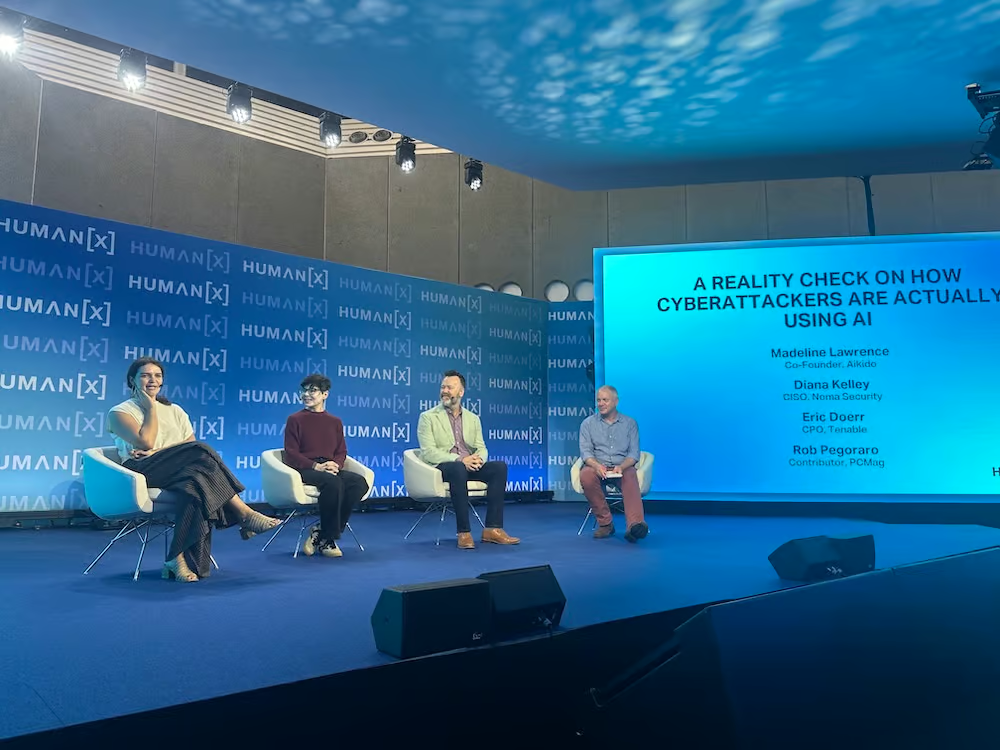
“Everything hackable can and will be hacked,” Aikido Security co-founder Madeline Lawrence said during a panel titled A Reality Check on How Cyberattackers Are Actually Using AI.
This would not necessarily be because of new technology, she argued, but because companies had not enforced basic security controls like multi-factor authentication.
Lawrence predicted the level of hacking was going to rise sharply, due to these failures combined with the fact attackers can now find a vulnerability in seconds using AI automation.
Tenable Chief Product Officer Eric Doerr agreed, arguing attackers are not using AI to create new categories of attack, but are instead getting better at finding weaknesses.
He said a fair number of enterprises had built their security strategy around being “not the worst,” and that the economics of attacks were changing significantly. Everybody had to up their game, he said.
Noma Security CISO Diana Kelley made the same point. “AI has not actually found a unique novel attack,” she said. Instead, AI was “lowering the cost of doing business for these hackers.”
AI inside the business
Rather than focusing on automatous attacks compromising organizations, much of the discussion focused on how security teams can better govern AI deployment inside the organization.
Doerr warned enterprises were growing their attack surface as they deployed AI, introducing a new era of insider risk as agents increasingly have access to all of the most valuable data in an organization.
He described a contractor who deployed an unsanctioned AI agent into a customer’s cloud environment and connected it to a personal Telegram account for remote access, bypassing the customer’s controls.
Kelley said attackers would be able to get into a lot more accounts and pointed to how companies had permissioned their own AI tools. “We’ve been trusting LLMs are going to figure it out because they’re so smart. They’re not,” she said.
A slowdown would not change the risk
Asked whether AI development should slow down, Akamai EVP and CTO Robert Blumofe said he was “skeptical that the slowdown would really be meaningfully implemented,” and doubted it would matter. He said he would rather see a concerted effort to put governance and visibility requirements in place.
He also warned against over-reliance on keeping a human in the loop. “Oftentimes what people mean by ‘human in the loop’ is the human is the guardrail. We can’t trust the LLM, so the human is the guardrail,” he said.
He urged anyone designing an agent to create “a meaningful human interaction that puts the human, us, in a place where we can add value.”
Kelley said the threat did not depend on future models. “We do not need the next breakthrough to cause significant harm with AI,” she said. “We can do that with the AI that exists right now.”
Doerr warned against blocking AI adoption. “Anybody that thinks they need to not adopt AI in thejeormy enterprise for security is doomed,” he said “The best way to have people work around what you do is tell them no.”