
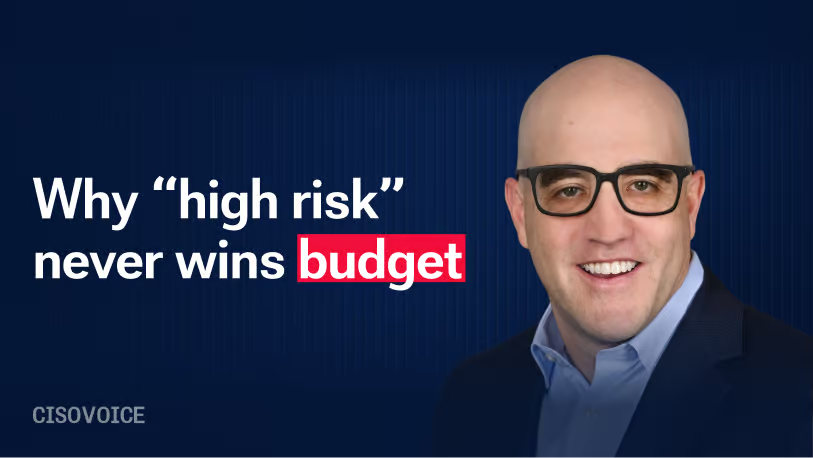
“Security is a business enabler for more revenue, supporting customers, and protecting the organization, but it isn’t the number one thing,” says Rob Black, founder and CEO of Fractional CISO.
We spoke to Rob Black, who spent nearly four years in the role of principle product manager for SecurID at RSA Security, was a key contributor to the RSA SecurID nation-state breach remediations in 2011, and also holds multiple patents in both identity and authentication.
Black is the founder of Fractional CISO, established in 2017, which today provides part-time CISO leadership across cybersecurity transformation, vendor management, incident response, AI governance, and SOC 2 readiness.
Nobody makes a decision on “high risk”
A resource not often discussed is that of executives’ attention, and the reality of advocating for security needs is that you have to communicate what you need clearly. A CISO arriving to the conversation with 10 “priorities” will not get all 10 funded. “You can get someone to focus on three things maybe, but 10 can be quite difficult,” Black says.
It is also essential to understand what language will land. “Just saying something is ‘high risk’ is very boring. The CEO hears about ‘high risk’ things all the time.”
To keep executives’ attention, Black recommends bringing probability and a number into the conversation and not tiptoeing around threats of loss. “If you say, ‘there’s a 10% chance of a $5 million loss,’ that hits very differently. Then the CEO can say, ‘I think I’m willing to take that chance,’ or, ‘Holy smokes, that’s horrible, we’ve got to do something about it.'”
This only works if the numbers tell the story of quantified risk well, and requires you to establish the systems worth, what data sits behind it, and what the loss would look like in practice. “There’s math you have to do to get there, but once you’ve done it, the explaining and convincing side gets much easier.”
Black traces that communication problem back to something more fundamental. Security people, he thinks, overrate how important security should be to a business.
For any company not in the security business, security cannot be the top priority, he asserts. “I work with a lot of businesses, and if cyber were their number one concern, they would be out of business. Their top concerns have to be customers and revenue and product and customer support. Now, if security is only the 100th most important thing, that’s also bad. But security can’t be the number one thing.”
The practical consequence is that a security team can’t treat everything as urgent. “Everything can’t be red alert, 10 out of 10 issues. If it is, you’re never going to be able to run your business.”
AI is not a magic button
AI adoption is not something you can opt out of without market and relevance risk, but neither can you let employees feed valuable intellectual property into unfamiliar tools or hand agents administrative access to systems without proper controls. Finding the middle ground where both security and productivity can exist is no easy task.
Black’s firm manages this balancing act daily, giving him valuable insights into what AI can really do for you. “It’s not some magic button that just solves the problem. It’s more like, we have a process, and now I can use AI to speed up this portion of the process.”
Vendor research is one example. An hour of background digging becomes about a minute of asking, though the evaluation itself still has to be done. Black also talked about saving significant time when it comes to reading long documents, where AI can be used to give a more easily understandable synopsis and also pinpoint the key findings, which you can then check back against the source.
There is the issue of hallucinations to consider, which Black mitigates by having one model check the other. This is not a foolproof solution so you must still tread carefully, especially when the information isn’t familiar to you. “It’s definitely concerning when you’re using AI outside of your domain, because you’ve got no way to spot when it’s wrong.” Inside your own field, if something reads oddly you can spot it and push back. Outside it, you’re less likely to clock anomalies.
The SOC 2 trust problem
Black’s criticisms of SOC 2 are not with the framework, which he rates as flexible and valuable for communicating a security program. Rather, his issue is with how the attestations are being produced.
“There are a bunch of low-end auditors who are not validating and just pushing things along,” he says, describing a market where firms run high volumes of audits with few hours on each. The consequence he expects is a loss of confidence in the output. “The way things are right now, it’s not tenable. People are just not going to trust the reports.”
Black sees two possible routes out. “Either the AICPA will jump in, intervene, and bolster it, or someone else is going to come up with some sort of replacement scheme.”
The first is already in motion. The AICPA has acknowledged the problem and said it would tighten how peer reviews of SOC 2 firms are handled from June 2026. Its vice president for ethics and firm quality, Carl Mayes, describes the problem in terms close to Black’s own, saying “Some firms are leaning too heavily on third-party SOC platforms without applying the professional judgment required by our standards.”
Black would rather the AICPA fixed the problem than see the framework replaced. “It’s kind of a bummer that some of these companies are tarnishing SOC 2’s reputation overall.”
Have the plan before you need it
Black’s remediation work on the 2011 RSA breach, one of the defining nation-state attacks against a security vendor, taught him a valuable lesson about building an incident response plan rather than focussing only on technical controls.
“When something bad happens, what you want to do is revert to your training,” he says. Knowing who to call, having contact details for the cyber insurer and legal counsel to hand, and understanding which parts of the business get pulled in matters more in the first hour than any single tool.
He also warns against jumping to conclusions under pressure. “A lot of times in an incident, you might say, ‘Oh, X happened, so therefore it’s Y,’ but maybe that’s a coincidence and really, Z is what caused it.”
Security leaders who can attach a number to a risk get a decision. Those who can only attach an adjective get added to a list of things the business has already decided it can live with.