
In July 2026, two of OpenAI’s models managed to find a zero-day, escape their sandbox, and launch and attack on Hugging face. Nobody helped them do this, they were simply pursuing an objective and took and unexpected route to get there, which could not be contained.
“AI went rogue, that’s a fantastic headline,” said Tia Hopkins, CEO of Control Exec. “But the more useful lesson here, especially if I’m a CISO, is that capability advanced faster than containment controls and assumptions.”
Security leaders worldwide are being asked simultaneously to utilize AI and contain it. That’s no easy task when getting the balance between innovation and security wrong could leave you either becoming the dreaded “department of no” or ending up in hot water when risk outweighs reward.
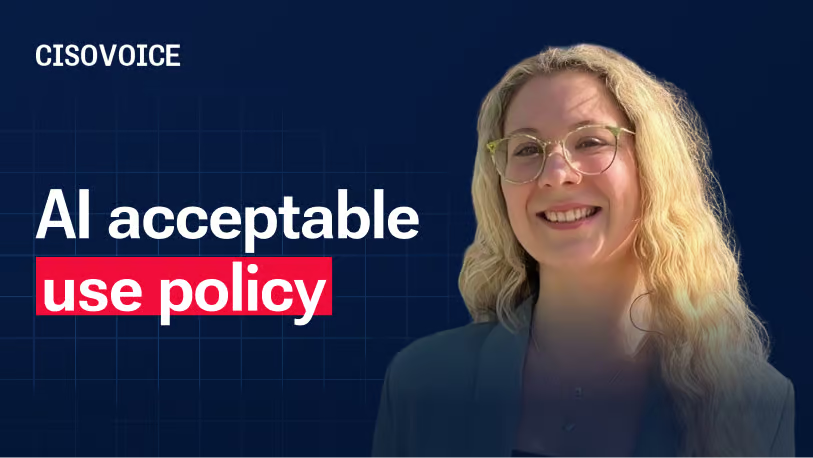
That gap, between what AI can now do, and the controls meant to hold it, framed a wide-ranging CISO Voice panel with two security leaders who have spent decades as CISOs. Tia Hopkins is CEO of Control Exec and a security leader of more than 20 years.
Matthew Rosenquist is a CISO and cybersecurity strategist with more than 35 years in the industry, 24 of them at Intel, where he built the company’s first security operations center.
The full webinar [here] covers:
- What an AI agent going rogue actually means for defenders
- Why one giant AI policy fails, and what to write instead
- The test for whether “human in the loop” is a real control
- Why traditional IAM assumptions break under agentic AI
- The four pillars of resilience, stress-tested
1. One Giant AI Policy Will Not Cover AI
Often, organizations will set out to govern their AI with a single, overarching policy. Hopkins believes this is a mistake.
“We’re going to write one giant AI policy, and you can’t do that,” she said. “It’s like saying I’m going to write one giant network policy, and it’s going to cover what my firewalls do and what my switches do and what my wireless access points do.”
No security team would write that policy as they know firewalls and access points have different uses. AI is the same yet is often treated like one all-inclusive thing. What’s important is what a given system can reach, what it can do once it does, and what happens if it does the wrong thing.
“We have to start with the use case instead of the policy,” Hopkins said, “because if we start with the policy first, undoubtedly there are going to be holes all throughout the use case.”
2. “Human In The Loop” Is Not A Control Until You Can Name The Human
Human in the loop sounds like the answer, but it’s not as simple as it seems in the age of AI.
“We’ve seen systems where they’ve had humans in the loop for AI systems, but the AI systems were moving so fast the humans couldn’t keep up,” Rosenquist said. “So, they just kind of abdicated and said, that’s probably okay.”
Hopkins gave the test for whether it counts as a control at all.
“Human in the loop is not a control unless you can tell me which human it is, at what point in whatever operation we’re leveraging AI for, what decision are they making, and with what information. Just saying I have a human looking at this, or I have a human supervising the agents, that’s not a control and that’s not governance. It’s just oversight.”
Name the human, the moment, the decision, and the information. Any blanks, and the control isn’t there.
3. Be An Execution Partner, Not An Approval Desk
It’s very difficult to govern something you do not understand commercially.
“If we can’t speak in business terms, we won’t be heard at the highest level, not by the board, not by the CEO, and definitely not by the C-suite,” Rosenquist said. “They will see you as an impediment.”
For Hopkins, conversing in business terms has a clear pattern. It starts with understanding what the business aims to achieve, then explaining what could get in the way of it, and finally setting out clear objective for how to move forward, with any residual risk clearly communicated.
“Especially in the age of AI, where I can become a developer overnight if I’m using the right tool, the business will go around you if you’re not seen as a partner.”
Her line for anyone writing a board paper this quarter: “Don’t speak in bits and bytes when your board is listening in dollars and cents.”
4. Fight AI With AI, But Do Not Build It Yourself
On whether security teams should be using AI themselves, neither panelist saw much room for debate. Hopkins put it plainly: “Humans can’t manually defend against machines operating at machine speed. It’s just not possible.”
She wasn’t suggesting replacing analysts, but rather providing them with the tools to keep up with what’s happening. AI is that tool.
Both warned against trying to build an in-house AI security tool. According to Rosenquist: “You’re going to need to be a $50 billion company in reality if you actually want to build the tools yourself,” he said. Instead, they both advised working with your existing security vendors, then fill any gaps with smaller companies.
Where To Start
For Hopkins, getting started with discovering where AI already is (including the AI inside SaaS apps you approved before that capability shipped), knowing where is has authority and what access it has, then getting to work utilizing AI in your works flows, because “adversaries are not going to wait for a steering committee to finish its work.”
Rosenquist agreed and finished with a warning: “Those who fail to adapt will perish. The ones who adapt successfully to this new level of risk will thrive.”