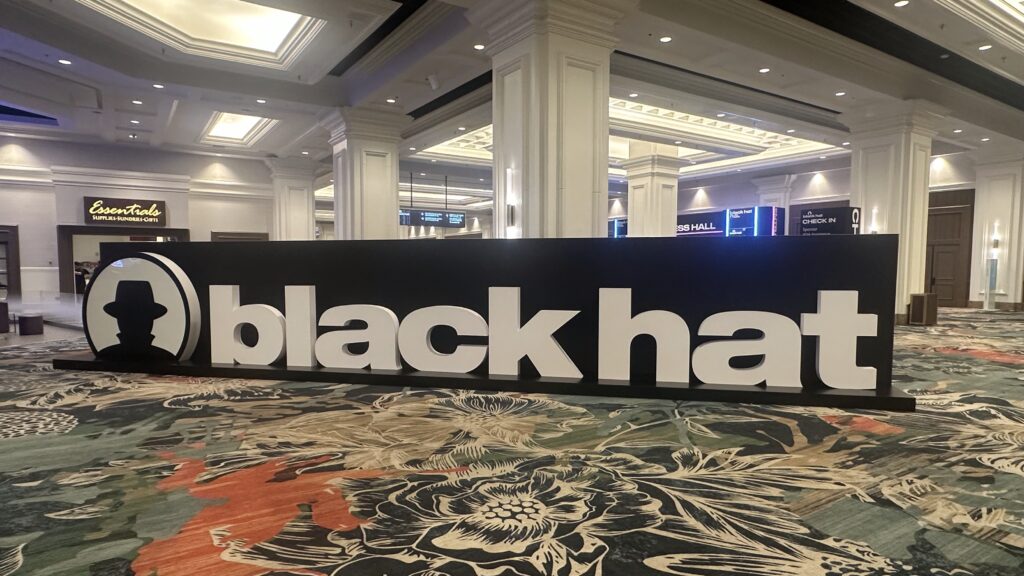
A busy week closes in Las Vegas as upwards of 20,000 cybersecurity professionals headed out to the scorching desert for the annual ‘hacker summer camp.’ AI dominated almost every conversation at the show this year, with huge discussions around the frontier model capabilities in the wake of the news an autonomous AI agent had breached Hugging Face, a few weeks before the show.
But below the surface noise there was a definite trend at the show this year to take a deep breath and think more deeply about what the challenges really are when it comes to AI, and how we can build more resiliency against them. Here’s a few things that stood out.
1. Frontier AI capabilities are not just hype
The first key point is that the industry noise around frontier model capabilities is not just marketing hype. Experts told me these models are highly capable at stringing together vulnerabilities and compromising systems.
“It’s not hype,” Zscaler’s chief security officer, Deepen Desai tells Expert Insights. “It is a step-function change from what the previous models are able to do.”
Zscaler was among the first 40 organizations given restricted access to Anthropic’s Mythos and OpenAI’s GPT-5.5 cyber model and spent 90 days running them against its own code.
The models didn’t just find bugs; they wrote working exploits, generated patches, and then beat their own patches three times out of five. Chaining several weaknesses into an attack that once took days, now happens “in minutes,” Desai said.
“This is a radical transformation. It is going to change the adversary and what they’re capable of, and it’s going to change the defender,” John Hultquist, chief analyst at Google Threat Intelligence Group, told a roundtable this week.
“These are the worst these models are ever going to be,” said Rob Bair, who leads cyber and national security policy at Anthropic.
He acknowledged that Anthropic’s lead over open-weight AI models has shrunk, meaning teams must be prepared for vulnerability exploit windows to collapse even more than they already have.
2. We have to be proactive in preparing for AI risk
The second key theme heard again and again was that the historical pattern of improving security – waiting for a crisis to hit and then securing against it after the fact – cannot be the case when it comes to AI risk.
“For the past decade of federal cyber policy, we’ve really been in reactive mode,” Mike Duffy, the US Federal Chief Information Security Officer, told a panel. “We can’t wait for the next crisis to happen. We likely won’t have time to pick up the pieces.”
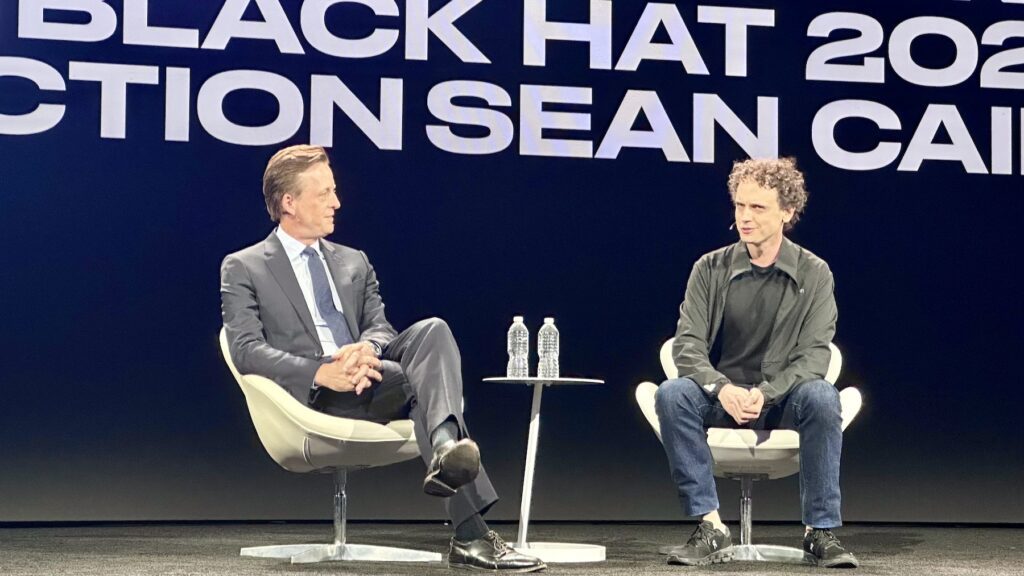
But questions still remain about what exactly being proactive looks like. In the opening keynote at Black Hat this week, US National Cyber Director Sean Cairncross argued against heavy AI regulation on the grounds that any rule would be out of date within 48 hours.
So, if the pace of threats is moving faster than we can respond, what does a proactive AI strategy look like?
3. Zero trust is not optional
One answer to this question for security defenders is strong zero trust enforcement. Crucially, zero-trust policies must be applied to AI agents themselves.
Dhawal Sharma, Zscaler’s EVP for AI security, said there is a “crisis situation in enterprises where they don’t know what identities have access to what.” Agents “have too many permissions,” because they inherit the full authorization of whoever created them, and then create sub-agents that multiply the problem.
ESET’s chief security evangelist, Tony Anscombe, told me that ESET scanned roughly 900,000 AI “skills” and found about 3,000 malicious ones, some that self-modify to establish persistence, others that hunt for credentials.
“Assume that there will be vulnerabilities you won’t be able to patch,” Desai said. “If you use zero trust architecture the right way, those vulnerabilities will not be exposed to the internet.”
4. The basics still matter, big time
For all the talk of frontier models and autonomous capabilities what most resonated was that many, many businesses still do not focus enough on security fundamentals.
Jonathon Ellison, director for national resilience at the UK’s National Cyber Security Centre, called this moment “a correction” for years of under-investment. He said that around 20% of the kit currently deployed in the UK is already end-of-life or unpatched.
The industry, he argued, has put “too much emphasis on the faster detection of vulnerabilities” when lots of businesses are already sitting on top of critical vulnerabilities that still have not been fixed. The immediate challenge, he argued, is not agentic AI but the legacy problems organizations are already carrying, now colliding with a faster pace of attack.
It’s clear AI tools are changing faster than anything the industry has seen. But fundamentals have not changed at all. If Black Hat 2026 had one lesson, it’s yes, to start preparing for an AI future where autonomous agentic attacks could be the norm, but also to finally finish the basics organizations have been putting off.