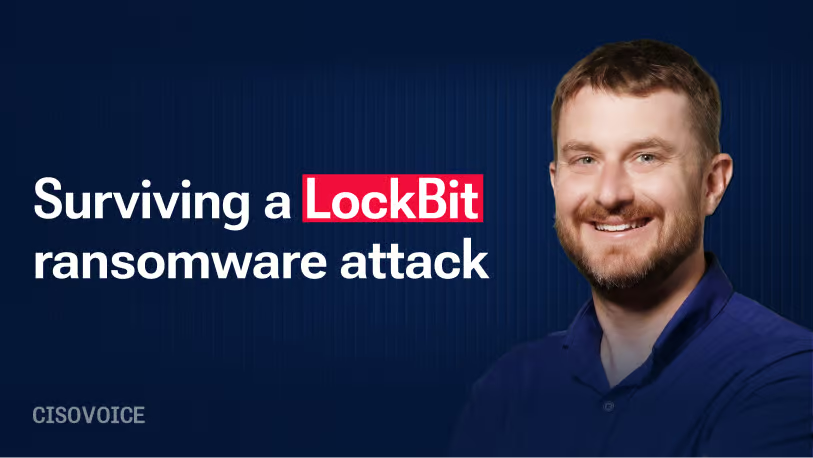
“From the moment you find that ransom note, you feel this sinking feeling in your stomach. This is the bad day, right?” says Zach Lewis, CIO and CISO at the University of Health Sciences and Pharmacy in St. Louis.
In April 2023, Lewis got a phone call early in the morning: the university couldn’t reach any of its on-site servers or services. On the drive to the office, he told his team it looked like an IT outage and nothing more serious. They got systems working again after a couple of days, but the attackers were still inside.
When the environment went down a second time, the team found a README file on the hypervisor, the software that runs the university’s virtual servers.
It was a ransom note from LockBit.
“This is what we’ve always talked about, and it’s now happening. And you start to wonder: am I a bad CISO? Is my program bad? What did I miss? Is it my fault this is happening to the company, to our end users and our customers?”
For years, a breach like this meant the CISO would be fired. Lewis believes that has softened in the last couple of years, as companies accept that these attacks are going to happen and that the people who know where the controls failed are better placed to fix them than a new team learning from scratch. “We’ve got to be right all the time, and the bad guys just have to be right once to get in.”
But the fear is still there. “Am I fixing this for a company that’s just going to let me go when it’s done? Are they only keeping me around to the end? Am I going to be targeted personally by the ransomware group?”
All that stress couldn’t be easily shaken off at the door, either. “I remember calling my wife and telling her what had happened, and that I’d be working multiple late nights and wouldn’t be home. You bring that home with you.”
From the help desk to CIO and CISO
Lewis started his career in end user support before moving into network and system administration, working across tech startups, coal companies and co-location facilities. He joined the University of Health Sciences and Pharmacy in 2016 and has held both the CIO and CISO roles since 2021.
Calling LockBit’s bluff
At the time of the attack, LockBit was among the most prolific ransomware groups in the world. It ran as a ransomware-as-a-service operation, supplying its malware to affiliates who carried out attacks in exchange for a share of the ransom.
The group had a “cult-like” following, with people tattooing the logo on themselves. Its anonymous leader offered a million-dollar reward to anyone who could unmask him. “Very full of themselves, very confident, and a very efficient ransomware group,” Lewis says.
Lewis’s first call was to the university’s insurer, then the FBI. The university had an incident response plan and had practiced it, running a ransomware tabletop exercise with the executive team a few months before the attack, according to Lewis. “It had the first few steps of who to call and in what order, where our sensitive stuff was, insurance contacts, just the plan of action.”
But even the best plan has a shelf life. “A good incident response plan will help in the first few hours of any incident. Every incident is different, so it’s only so good for the first day or two, and then it kind of goes off the rails and you have to be adaptable.”
With threat negotiators and forensic specialists brought in, the university opened talks with LockBit on the dark web. LockBit demanded $1.25 million. Lewis has explained that the negotiations had two purposes: to verify what data LockBit had, and to buy time while his team got new equipment and restored systems from offline backups.
With essential systems restored, the university had no need for a decryption key, so LockBit changed its demand: pay, or the stolen data goes on the dark web. LockBit first claimed it had stolen 75 gigabytes of data, a figure that climbed to around 380 gigabytes as negotiations went on.
The team had only a handful of file names to judge what had been taken, but felt confident none of it was sensitive, so they let LockBit’s deadline pass. When LockBit posted the data, Lewis has said, it amounted to only around 2GB.
The university emailed students, staff, and alumni to say anyone affected would be contacted individually. In the end, Lewis had to contact four people, and he called each of them himself.
The gaps that let them in
Working out how LockBit got in took longer. Lewis believes the attackers likely phished an employee’s credentials on a personal device the university didn’t manage, then used them to come in over the VPN. Cached credentials on a server let them escalate their privileges until they reached the hypervisor. The university’s EDR tools never raised an alert, because they don’t run at the hypervisor level.
Lewis is open about what that revealed. “If you look back a little before that, though, and figure out how the threat actors got in, what they were able to do and why we weren’t alerted, you see some control failures.”
Since the attack, the university has moved almost everything to SaaS platforms and rolled out an enterprise browser, which gives Lewis’s team a single place to manage identity and user access. “You might get hit again one day, but you don’t want the same pathway to be used again.”
The work nobody wants to do
Ransomware is a billion-dollar-a-year business, and attacks continue to rise. Lewis does see fewer victims paying the ransom these days, which he puts down to better backup programs and more organizational resilience. But the payments that do get made are still very high.
Organizations like his are an obvious target. “Higher ed is severely underfunded, so it’s a prime target,” he says. Students bring “fresh data that’s untainted by debt, credit cards or accounts,” and hundreds of new accounts come in all the time.
Add healthcare data, research on new drugs and a lot of regulation, and the university is juggling all of it on a tight budget. “There’s a little bit of everything here, and not a lot of money.”
The root cause, Lewis believes, is the basics being habitually skipped. “I think there’s a lack of fundamentals, and they get missed because they’re not glamorous. They’re not sexy. Do you have internet-facing servers that are unpatched? Are we doing good patching? Do we have good identity? Do we have good data controls?”
Of those, he singles out two. “I think data and identity are the two big pillars that need some focus right now.”
“Let’s be honest, patching a server isn’t cool. It’s not a new tool, and it’s not a new startup coming out. Hundreds of new startups come out every year, but obviously the problem’s not getting any better. So, where’s the disconnect?”
According to Lewis, while the dramatic stories garner more attention, it’s the less exciting moves that win the game. We can talk about cult-like ransomware groups and seven-figure ransom demands, but what decided the outcome at a small university in St. Louis was comparatively dull, yet effective: a plan that had been practiced and backups that worked. The holes that let them in were just as ordinary, and nobody had spotted them until afterward.
Most people who learn that lesson never get to pass it on. Luckily for us, Lewis could.
Lewis’s book, Locked Up: Cybersecurity Threat Mitigation Lessons from a Real-World LockBit Ransomware Response, covers the attack from start to finish, including the negotiations, the decisions the team made and why, the emotional toll on Lewis and his team, the disclosures, and everything the university changed afterward.