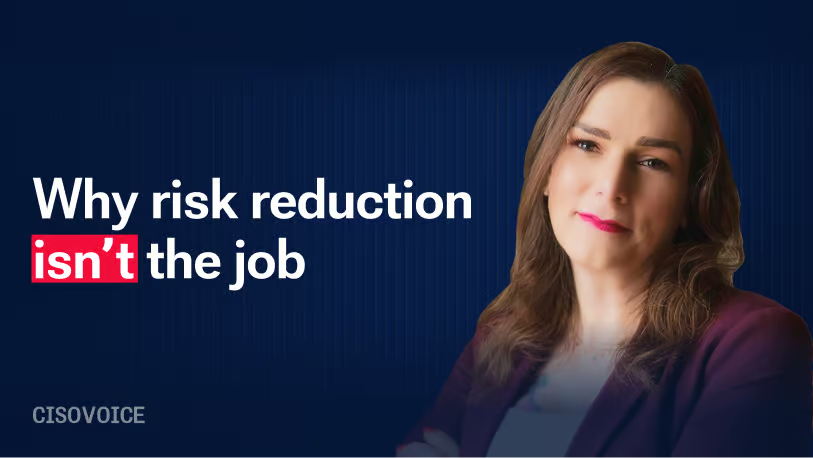
“The CISO isn’t a cybersecurity expert who reports to the business, they’re a business executive whose domain of responsibility is cybersecurity,” says Alyssa Miller, former CISO at Epiq Global.
Miller spent a decade and a half working in a multinational financial services company, beginning in software development and eventually taking on the task of leading the security test team responsible for running penetration testing, securing applications, and managing vulnerabilities.
After a decade of consulting, Miller returned to financial services as a BISO (Business Information Security Officer) and then spent four years as CISO at New York-based Epiq Global. Named a Board Director to Watch in 2025, she now sits on the board at Epiphany Solution Group and the CxO Advisory Council at Evolve Security.
Risk reduction isn’t the job
A central argument Miller makes is that the professional identity of the CISO has been built around the wrong core component: risk management. Risk management can’t be what makes the role valuable, because it is not unique to the CISO role.
“Every C-Level executive in the room is responsible for risk management, that’s just a facet of wearing that title,” she says. A CFO reduces financial risk, but earns their seat by responding to market conditions and interest rate trends. HR keeps the company clear of employment law but earns its seat by recruiting well and holding down the cost of turnover. Security, she argues, has never made the equivalent case for itself.
“We tell ourselves and our organizations that reducing risk is how we enable the business, but that’s just not a true statement.” The industry built a great deal of its messaging on that fallacy, she says, and the result is that the CISOs is valued below their peers in the C-suite.
It’s also true that the subject of security has never been purely technical one. Miller highlights the issue of fraudulent remote workers, particularly North Korea-based, as a risk that concerns HR more than IT. “This is not a technology problem, and it requires a response that spans process changes, technology capabilities, and people-centric education.”
HR teams typically don’t have the expertise needed to handle this like of risk, which is where a security leader comes in, showing their value through diligent threat analysis and problem solving rather than through security tooling.
What belongs on the board deck
That gap between what the business values and what security provides shows up starkly in board meetings.
“When CISOs come to a board meeting with a bunch of numbers about vulnerabilities, mean-time-to-detect, mean-time-to-resolve, it doesn’t speak to what the board is concerned with,” she says. For boards, what they really want to hear about is business growth, whether the business is positioning itself as a market leader, and what to be aware of that might derail that goal.
Instead, Miller coaches CISOs to come prepared with a roadmap, one tied to divisional goals with clearly outlined value-add that everyone in the room can understand: reduce cost, reduce complexity, stronger organizational efficiency, new channels of revenue, a better customer experience.
“Presenting and then tracking to that roadmap shows that we understand our role as business executives, not just cybersecurity experts.”
Discovery must meet action
Miller’s objection to how most security programs run today is a practical one. Her issue is that often findings are generated, but nobody ends up acting on them. These perspectives are justified by her time pen testing, various CISO seats, and advisory roles on boards.
“I had those customers that we’d test year after year and always find the same vulnerabilities, unaddressed from the previous report,” she says. Most organizations commission the test for compliance, then treat the report as the deliverable. The result is the same overwhelming to-do list that a vulnerability scanner produces, and a once-a-year exercise that costs five or six figures and result in little changing.
Instead, she endorses continuous testing which feeds into the automation, to ensure that findings are prioritized and acted on as part of daily operations, with security engagement in DevOps pipelines speeding up deployment rather than gating it. “Value comes when discovery and action are a part of our daily operations.”
That same gap between discovery and action appears again during an incident, this time with an even smaller window of opportunity to act. Miller’s advice for how to tackle those crucial first 30-minutes is to get the right first responders engaged and formally declare the incident, something many organizations hesitate to do, to their own detriment.
“There is a bias in these situations away from declaring an incident because that brings with it a lot of legal implications.” This hesitation has an operational cost, not just a procedural one. Ad-hoc response stretches out containment, and it can tip off attackers, who then shift into avoiding detection and digging in.
Declaring the incident quickly gives the CISO something to stand behind when the executive team starts demanding a root cause nobody can have yet. Then, with a methodical plan and playbooks in place, the answer becomes the process and the progress through it. “We radically accept the situation we’re in by declaring an incident.”
The AI opportunity nobody’s discussing
Miller’s team at Epiq worked AI across four fronts:
- Securing third-party platforms arriving with AI built in
- Securing the company’s own AI product development without slowing it down
- Defending against attackers using AI to find and exploit weaknesses
- Building the security team’s own AI capability
However, in conversations around AI today, only that third point seems to get any airtime, and Miller thinks this imbalance is a big mistake. “Every CISO conversation I’ve been in over the last 6-9 months has focused on the threats of attackers using AI, not excitement over how we can leverage it to our own advantage.”
Point number 4 is one Miller wants to see get more focus. “The over-indexing on the risks of AI and the failure to fully embrace its capabilities will be terribly impactful in the coming year.” Her reasoning is that the two aren’t separable. Teams that build and operate these systems develop the expertise to defend against them, so the organizations treating AI purely as an incoming threat end up worse at handling the threat as well as missing the upside.
If the CISO is a business executive, security certification is not the only qualification that matters. Miller advises CISOs to diversify their skillset, recommending the pursuit of an MBA, reading The 10 Day MBA, or finding some other route to fluency in how business leaders actually think. “We need to be part of the business leadership, but if we can’t understand those core concepts that drive business decisions, we’ll always be on the outside looking in.”
None of that makes the risk go away, and Miller isn’t suggesting CISOs stop managing it. But she advises CISOs to see it for what it is, which is one facet of the role, and not the thing that earns them a seat where the decisions making is happening.