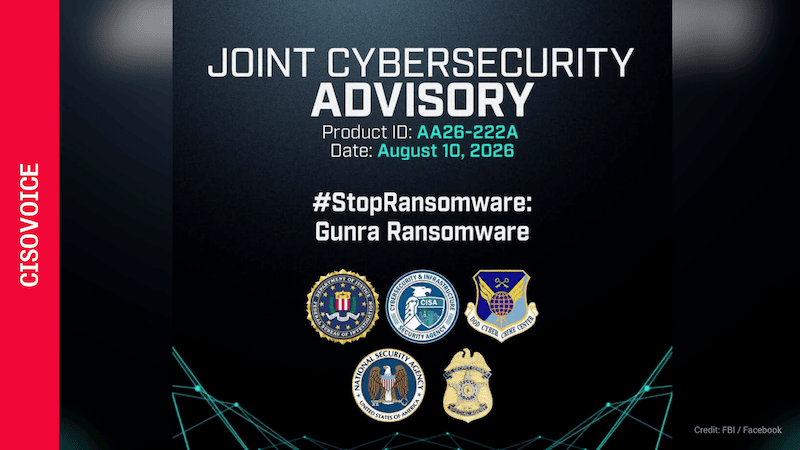
The FBI has observed Gunra ransomware affiliates getting into victim networks primarily by exploiting known vulnerabilities in internet-facing firewall and VPN appliances, according to a joint advisory published on Aug. 10 by five US agencies and Korea’s National Police Agency.
The bureau observed exploits based on two authentication bypass flaws in FortiOS and FortiProxy, CVE-2024-55591 and CVE-2025-24472. They share a weakness class, and Fortinet’s January 2025 update closed both.
The first entered CISA’s catalog of known exploited vulnerabilities on Jan. 14, 2025, with a remediation deadline for federal agencies of Jan. 21, seven days later. The second followed on Mar. 18, 2025, after researchers at Forescout found a LockBit-linked group exploiting both flaws to deploy ransomware.
Exploiting either flaw lets an attacker create a persistent account named forticloud-sync with super user privileges, so an unexpected account by that name is a quick check on affected devices.
Gunra steals data before encrypting it and gives victims five to seven days to negotiate before publishing to its leak site.
Korean investigators separately found the actors reaching an SSL-VPN administrator account protected by default credentials with no lockout controls.
The Authentication Backdoor
The advisory also recorded the actors modifying authentication processing files on a corporate virtual desktop portal so that one value of their choosing always passed as a valid one-time password (OTP). That left a standing route past multi-factor authentication (MFA) rather than a single hijacked session.
They abused the traffic controls on an SSL-VPN appliance to capture credentials as users authenticated, replayed the stolen cookies to impersonate them, and took a symmetric key from an access control server that decrypted stored passwords for every enterprise server.
The actors typically deleted access logs and cleared command histories, and mostly worked between 10pm and 6am, though the advisory does not say in which timezone.
Against one victim they deleted backup and archived data at both the primary data center and the disaster recovery site, before and after deploying the ransomware.
Chris Butera, CISA’s acting executive assistant director for cybersecurity, said organizations should “urgently mitigate vulnerabilities identified in this advisory.” The agencies also recommended immutable offline backups and network segmentation.