
A new report has argued that criminal use of AI models has crossed a threshold this year, and that security leaders have roughly six months to prepare before AI-native attacks become the default rather than the exception.
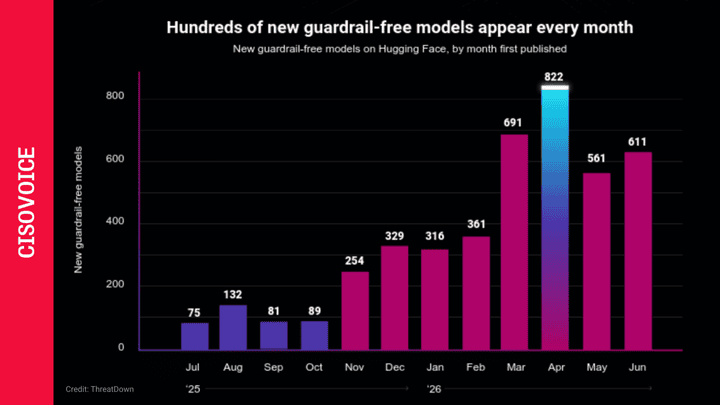
ThreatDown, MalwareByte’s Threat research division, documented 6,644 models published openly on Hugging Face under self-declared guardrail-free labels such as “abliterated,” “uncensored,” and “unfiltered,” which together accumulated tens of millions of downloads in a single 30-day window.
Publishing volume for these models grew roughly threefold between the final quarter of 2025 and the second quarter of 2026.
Alongside the open-source models, ThreatDown mapped a marketplace of malicious AI storefronts, including WormGPT, Xanthorox, Kriminal, and DadGPT, served through legitimate infrastructure providers like Cloudflare, Google Cloud, Anthropic, and OpenRouter, among others whose APIs and infrastructure are being abused or resold without their authorization.
The report characterizes most of these as jailbreak wrappers or API resellers rather than custom-trained criminal models: “The criminal AI market doesn’t build intelligence. It rents it from the legitimate AI industry.”
Concrete incidents cited include Anthropic’s documentation of Claude Code abuse across roughly 30 targets, used by a nation-state actor for automated reconnaissance and credential harvesting.
ThreatDown also cited APT28’s LAMEHUG malware and Google Threat Intelligence Group’s May 2026 identification of what it believes to be the first zero-day exploit developed by criminals using AI.
Six Months, and Something to Sell
The report recommends that organizations focus on patching aggressively, monitoring continuously, and discovering shadow AI. This advice reflects ThreatDown’s own stake in the market as a provider of AI-driven MDR. The six-month timeline is ThreatDown’s own characterization.
For CISOs, the important question is not whether ThreatDown’s six-month timeline proves accurate. It is whether their current patching, monitoring, and shadow-AI controls still assume attackers operate at human speed.
However, the pattern is corroborated by independent evidence. Anthropic disclosed in April 2026 that its Claude Mythos model had proved capable enough at finding software vulnerabilities that the company withheld it from public release.
Firefox subsequently shipped 423 security-bug fixes in April 2026, compared with 31 the previous April, during an AI-assisted security push in which an early version of Mythos directly identified at least 271 of the fixed vulnerabilities. On the defensive side of the same equation, Microsoft’s own AI bug-hunting system has also uncovered new vulnerabilities in Windows.
AI-assisted reconnaissance, vulnerability discovery, exploit development, and autonomous intrusion are already moving from demonstrations into real campaigns. For internet-facing enterprises, the shift is no longer hypothetical, and waiting for AI-native attacks to become routine will mean adapting after the advantage has already moved to the attacker.