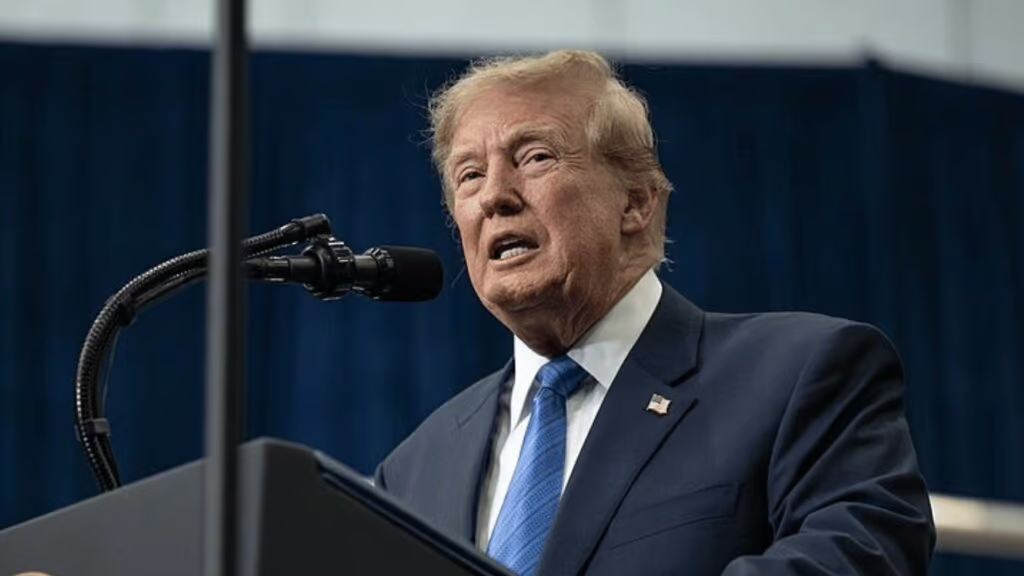
US President Donald Trump on Tuesday 29th September announced the White House Accord on Super Intelligence, which calls on AI companies to ensure model safety. Additionally, Trump signed an executive order that will require federal departments to use the term “super intelligence” instead of “artificial intelligence”.
Google, Anthropic, and Meta CEOs Sundar Pichai, Dario Amodei, and Mark Zuckerberg, alongside OpenAI President Greg Brockman, Nvidia head Jensen Huang, and xAI founder Elon Musk are among the signatories of the accord, which Trump co-signed.
“It’s almost like a constitution in a way, and the biggest people in the world signed that, and I signed it as president, and it really is a form of protection,” Trump said.
The initiative calls for four key layers of security and control. These include capabilities to monitor and audit models during training and deployment, an internal team to monitor model safety, an external auditor to independently assess model capabilities, and an independent committee of the board of directors to oversee and review reports from the teams operating controls and evaluations.
The companies will also collaborate to establish shared best practices to improve their model safety.
“Together, these steps will give each company, its customers, and the public confidence that the technology is operating as intended,” the accord stated.
“There is no conflict between innovation, technology and safety,” Nvidia’s Huang said on Tuesday at a White House event. “We are going to have to create new technologies to advance the capabilities of AI, but we are also creating new technologies to advance the safety of AI.”
Not everyone is convinced the accord goes far enough. “This announcement, though welcome, is ‘better than nothing’ rather than what is urgently needed. Self-regulation is not the answer, especially as leaders of the major AI labs have themselves called for external regulation to enforce a universal slowdown so that safety can catch up.”
Michael Adjei, Director of System Engineering at Illumio, said in a comment to CISO Voice. “This is where external regulation must step in to align everyone, and precisely where this announcement falls short.”
From Artificial Intelligence to “Super” Intelligence
The accord came alongside an executive order Trump also signed on Tuesday, requiring federal departments to use the terms “super intelligence” and “SI” instead of “artificial intelligence” in official correspondence, public communications, and policy documents.
The measures seek to “reflect the transformative capabilities of these technologies,” and put the US at the forefront of these developments.
“Using the name Super Intelligence will ensure departments and agencies remain focused on expanding the capabilities and applications of these technologies,” the White House said.
The White House-led initiative comes as OpenAI, Anthropic, and Meta continue to face severe criticism amid ongoing scrutiny following incidents in which their models accessed systems beyond their intended scope.
In Australia, for instance, a Senate inquiry chaired by Greens Senator Sarah Hanson-Young invited the Anthropic and OpenAI CEOs to appear, though Anthropic has said it will not attend. The invitation came after Australian Prime Minister Anthony Albanese disclosed that OpenAI models accessed a Medicare statistics portal.