
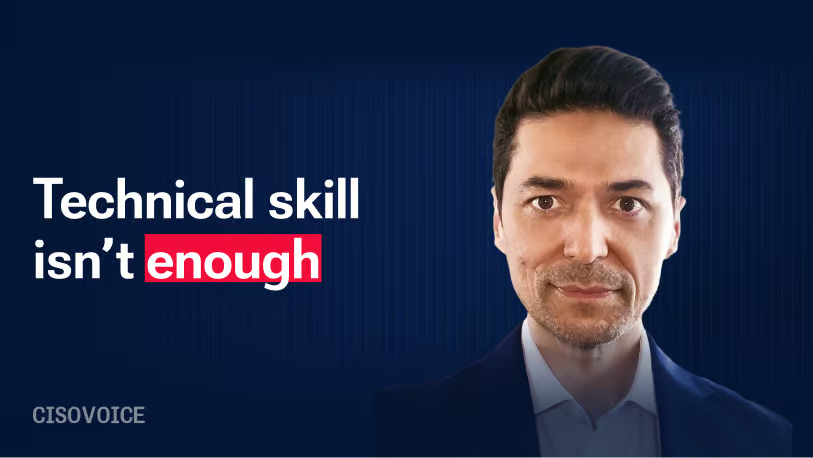
“The technical stuff is certainly important, but it’s not what makes a successful security professional, whether you’re an analyst or a CISO,” says Ali Waezzadah, CISO at iCOUNTER.
Ali Waezzadah began his career as a system and network engineer in the late 90s. He built his first security program at ICF International in the early 2000s, right as the company went public and Sarbanes-Oxley came into force.
Since then, he has held senior security roles at Kroll, CBS, Paramount, and Frontier Communications. In his most recent previous role as SVP and CISO at Frontier, he was able to rebuild the security organization while the company was still in the process of emerging from Chapter 11, and stayed through its acquisition by Verizon.
Today, Waezzadah is the CISO at iCOUNTER, a cybersecurity organization that came out of stealth earlier this year.
What are the skills a new CISO really needs?
Waezzadah’s challenging of the importance of technical skill starts with him asking the question: When you strip it down, what is the discipline of cybersecurity really for?
“People say things like ‘protect the company,’ but what does that actually mean?” Waezzadah asks. “At the end of the day, you can’t protect the company from everything that’s out there.”
He reckons the job has three key components, not just one. The first is that of a risk advisor, because making risks visible and conveying them in language the wider organization can understand ensures they are acted on or, at least, there is awareness of them. “Even if there’s nothing that can be done, you still bring visibility, because you don’t want the business coming back later saying, ‘had you told me this, I would have done X.'”
The second is the role of solution provider; setting out the ways the risk could be handled and what each one would take. “You explain the options for dealing with that risk. Some are expensive, some are cheap, some are more process oriented.”
The third is seeing it through by keeping ownership of the work rather than letting it diffuse across departments. Waezzadah warns that “sometimes something gets approved and then it hands off from department to department, and by the time it finishes, no one is entirely sure whether it actually got done.”
It’s noteworthy that none of those three jobs are technical. According to Waezzadah, the CISO profession often measures the wrong skills, and what separates a successful security professional from a struggling one is business acumen, financial understanding, good communication, proper team management, thorough risk management, and having some capacity for conflict resolution.
That doesn’t mean he dismisses the technical layer entirely. Foundational understanding is important, but he does not see technical depth as the skillset that most influences the trajectory of CISOs’ careers today.
What should a CISO do before they start building?
Having stepped into the CISO seat more than once at companies that had not had one before, Waezzadah now has a pretty good idea of what to avoid. Something he described as a mistake he made early in his career was skipping the necessary conversations and jumping straight into building.
“In my earlier roles, we just started building things. Then we’d go to the business with what we’d built, and they’d have questions and concerns, and we’d have to go back and rework it.”
Having learned that lesson, he now enters a new role with a short set of questions he puts to each of the executive stakeholders. These are:
- What are your top risks and priorities?
- What does cybersecurity mean to you?
- What is your perception of the cybersecurity team?
- What is your expectations of the cybersecurity team? What are the issues and challenges working with cybersecurity?
- How do you stay updated on cybersecurity and its impact to your team and operation?
It’s less about the questions; it’s about opening up the opportunity to hear the answers. “Sit quietly and listen. Even if what you hear seems that you completely disagree listen without judgment. That executive may end up being your strongest supporter down the road.”
Once you’ve opened up those communication channels, you need to keep them going. Waezzadah does this by setting up what he calls a Cybersecurity Council, within the first 90 days at a new role. This council is made up of executives across finance, legal, HR, technology, and the business, who meet every quarter to talk about what’s been done, what’s coming, and where the program needs some support.
What makes it all come together is who you put in charge. According to Waezzadah, “the key thing is to put an executive in the chair, not the CISO. You want the Council to be seen as a business function, not a security team’s initiative.”
In his roles, the chair has been the CEO, the CFO, or someone reporting directly to the CEO. This is a deliberate choice that can save time and energy later, so the program has visible backing from the top. “If someone lower down raises a concern about something the security team is doing, that executive can say, ‘I know about this. I was involved. Continue working on it.’ That’s how you avoid escalations that stop you dead in your tracks.”
Rebuilding security in a company that nearly didn’t make it
When Waezzadah joined Frontier, the company was just coming out of Chapter 11, with investors having replaced the board and the entire executive suite.
The security program he built for Frontier ran on four principles: it had to be business-focused, risk-based, technology driven, and always learning. That first point was key, because if the company did not manage to turn itself around, nothing else they achieved would matter.
Along with those four principles, he set a cap on how many tasks should be focused on at once. “Every time my management team came to me wanting to do six or seven, I’d say, ‘No — tell me the three things you can actually finish.’” There is no end to the security tasks needing to be done and more will always come, but the aim was to set achievable goals and avoid the year ending with ten things in motion, but nothing completed.
For Waezzadah, what gets finished counts for more than what gets planned. “Execution and completion matter much more than a roadmap you never reach the end of.” Milestones are fine, he says, as long as they lead somewhere rather than simply existing for their own sake.
Your team is not so fragile
From signing to close, the Frontier sale took nearly 16 months to complete. That was a long stretch for everyone, including the security team, to wonder where they would stand when it was all done.
Waezzadah’s approach was openness, not sugarcoating. “One of the lessons I learned early on is that you have to respect your team’s ability to handle good things and bad things. Don’t try to shield them because you think they might freak out. Your team is not so fragile.”
So, the team were clued in to the whole picture. For a year and a half, any questions, including the hard ones about retention or tools being retired, could be asked and would be answered honestly. The team was also given training and capability development, and the message stayed consistent: performing well leaves you in a good position, either inside Verizon or somewhere else.
Holding a team together in those circumstances was only half the battle. Waezzadah was very familiar with the issue of CISO burnout, having read the articles and seen the departures himself. Combating this needs openness, but it also needs a bit of human understanding.
For Waezzadah, this often looks like starting the monthly meetings with a personal anecdote, story and opening up about his own mistakes. “It’s okay to show that you’re human, that you fail, that you make mistakes. When your team sees that same person turn around and drive something significant forward, they understand that your perceived weaknesses or vulnerabilities don’t take away from your ability to execute something hard.”
The skills Waezzadah chose to focus on in our discussion may be slower to acquire than a certification, harder to evidence on a CV, and invisible in a tooling evaluation. But the CISOs who have them are, as Waezzadah sees it, likely to be the ones still standing when the platform gets replaced, the budget gets cut, or the company gets sold.