Shane Barney is the Chief Information Security Officer at Keeper Security, the zero-knowledge identity security platform used by millions of individuals and 95,000+ organizations globally to protect passwords, credentials, secrets, and privileged access.
Before joining Keeper, Barney spent years leading security in the federal government, including as CISO at US Citizenship and Immigration Services, where he was responsible for protecting the systems behind immigration benefits for millions of people.
We spoke to Barney as part of our ongoing series interviewing cybersecurity leaders to bring you their unique insights into cybersecurity today, the challenges they are facing, and the realities of what it takes to defend complex global environments.
Q. Before Keeper, you spent years leading security in the federal government, including as CISO at US Citizenship and Immigration Services. How did securing a federal agency shape your approach to the role, and what from that world do you still carry with you today?
Securing a federal agency teaches you two things that never leave you. The first is that security is fundamentally a mission-enablement function. At USCIS, the mission was immigration benefits for millions of people. If security got in the way of adjudicators doing their jobs, we failed, no matter how good our controls looked on paper. That framing carries directly into the private sector: my job at Keeper Security isn’t to say no, it’s to make the secure path the most efficient path.
The second lesson I’ve learned from working in the government is discipline around rigor and evidence. The federal world runs on Risk Management Framework (RMF), FedRAMP and continuous monitoring, and it forces you to prove your security posture, not just assert it. You can’t hand-wave your way through compliance. Every control has an owner, an implementation statement and evidence behind it. Where a lot of commercial organizations operate on assumptions and vendor dashboards, the federal mindset is “show me.” I still carry that with me in my role today. If we can’t demonstrate that a control is working, I assume it isn’t.
What I’ve deliberately left behind is the pace. Government moves at the speed of process; a security company has to move at the speed of the threat. The trick is keeping federal rigor without importing federal bureaucracy.
Q. What cybersecurity challenges are you and your team at Keeper focused on right now?
Three things dominate my whiteboard these days. AI governance is at the top, and I mean governance in the practical sense, not the policy-binder sense. Some of the questions we’re working through include which models should we allow, where does data flow and what does model provenance mean for our FedRAMP compliance? These questions cascade into our data governance and compliance structure. They’re challenges the entire security industry is grappling with right now.
Our second big priority is ensuring visibility and detection engineering. At Keeper, we’ve invested heavily in making sure our telemetry tells us the truth. We index the logs that matter, understand how attackers actually operate against identity infrastructure and ensure our government and commercial environments are monitored with equal rigor, even though they’re deliberately separated.
Our third priority is managing the machine identity explosion, which includes service accounts, workload identities, API keys and now, AI agents. Non-human identities outnumber humans in our environment many times over, and that ratio is only going one direction. Managing those credentials, keeping them rotated and ensuring they are least-privileged is where a lot of our engineering energy goes, because these are exactly the problems our products solve. We are, unapologetically, customer zero.
Q. There is a particular pressure to being the CISO of a security company: you are both a high-value target and, in a sense, part of the product. How does that change how you approach the job?
There’s no daylight between what Keeper sells and what we practice. When I evaluate a control internally, I’m implicitly making a statement about whether our own architecture holds up. Keeper’s zero-knowledge architecture means that even a full compromise of our infrastructure doesn’t expose customer vault data. We run adversarial exercises against ourselves and take the findings seriously rather than defensively, and we hold our own environment to the same standards our federal authorizations demand.
Q. Identity used to mean people. Now security teams are managing humans, machines, and increasingly AI agents, each with their own credentials and access. From where you sit, how fundamentally does that change the identity security problem?
The rise in NHIs and AI agents is the biggest structural change to identity security in twenty years, and I’d argue most organizations haven’t internalized it yet.
Securing human identities was challenging but bounded: you knew roughly how many employees you had, they onboarded and offboarded through HR, and their access patterns were fairly predictable. Machine identities broke that. They’re created programmatically, often outside any governance process. They don’t have a manager or a termination date, and they tend to accumulate privileges nobody remembers granting. Most organizations can’t even count them, let alone govern them.
AI agents further complicate the security challenge by removing predictability. An agent isn’t a static service account executing the same job every night. It makes contextual decisions about what to access and when, potentially chains actions across systems and can be manipulated through its inputs in ways a cron job never could. You’re no longer just asking, “Does this identity have the right permissions?” You’re asking, “Is this identity behaving how it’s intended?” which is a fundamentally harder question to answer.
The practical implication is that identity security is now a data problem and a runtime problem, not a directory problem. You need an inventory of every credential-bearing entity, human or not; you need those credentials vaulted, rotated and time-bound rather than standing; and you need behavioral telemetry good enough to notice when an agent does something its purpose doesn’t justify. Organizations must treat non-human identities as a priority, not just a footnote to Identity and Access Management (IAM).
Q. There is a lot of noise around agentic AI risk right now. As a practitioner, how real is the threat today versus twelve months from now, and what is the first practical step a security team should take to get ahead of it?
The agentic AI risk is real today, but not in the way the headlines may suggest. The near-term risk isn’t a rogue autonomous AI launching attacks against your organization, but rather, the risk is more likely to be your own well-intentioned agents being over-permissioned, under-monitored and manipulable. Prompt injection is a live, working attack class right now. If you’ve deployed an agent that can read external content and take actions with real credentials, you’ve built a confused-deputy problem, and attackers have already figured that out.
We’re seeing shifts in the cyber threat landscape as agentic AI becomes more pervasive. The first shift is attackers increasingly using agents to scale their own operations through reconnaissance, phishing and vulnerability chaining at machine speed. The second shift is enterprise agent adoption outpacing enterprise agent governance. These threats are very real and security teams cannot afford to delay implementation of critical identity security controls for non-human and human identities alike.
Q. Least privilege has been preached for decades, yet standing privileges are still everywhere. Why has this been so hard to fix in practice, and what actually moves the needle?
The cost of under-provisioning is immediate and loud in the form of a ticket, an escalation or a frustrated engineer at 2 a.m. who can’t fix production. The cost of over-provisioning is invisible and deferred, showing up years later in an incident report. Admins under time pressure resolve that trade-off in the same direction, and standing privilege accumulates like sediment. It’s not a knowledge problem; every practitioner has known the principle for decades. Rather, the lack of least-privilege enforcement is an incentive and friction problem.
What actually moves the needle is changing the default access control from standing to ephemeral. Just-in-time access means privilege is granted for a task and a time window and then evaporates. It attacks the root cause: there’s nothing standing to accumulate, so there’s nothing for an attacker to harvest. When elevation takes seconds through automation, engineers stop fighting it, and the secure path becomes the convenient path, the only version of least privilege that survives contact with a real engineering organization. Pair that with vaulted, rotated credentials for everything non-human, and you’ve eliminated the two biggest privilege stockpiles in most environments. The technology for this exists today; what’s usually missing is the willingness to make ephemeral the default rather than the exception.
Q. What do you think most boards still get wrong about cybersecurity, and what would you change about how security is represented at board level?
The most common cybersecurity failure at the board level is treating it as a periodic briefing rather than a standing dimension of business risk. Security gets thirty minutes twice a year where the CISO shows a maturity heat map that’s green-shifted for the audience, everyone nods and the board has technically “overseen” cyber risk while learning nothing useful.
There are two specific fixes for this. First, boards should demand that security be reported in the language of business consequence, not technical activity. Patch compliance percentages and blocked-attack counts are operational metrics, which are fine for me as the CISO, but useless for a director. What the board actually needs to know is the top scenarios of material loss, how exposed we are to each, what’s the trend and what’s the cost and timeline to change it. If I tell a board “We blocked 40 million attacks,” I’ve told them nothing. If I tell them, “A compromise of this system would halt revenue for a week, here’s our current exposure and here’s what it costs to fix it,” they can make an educated decision that benefits the organization.
Second, the best boards actively cultivate an environment where security leaders bring hard truths. That means asking sharper questions than, “Are we secure?” That’s a question that has no honest yes. Boards should expect assessments that go badly sometimes, and treat those as learning opportunities rather than performance judgments. The board relationships that work best are the ones where I can say, “This assessment exposed a gap we need to address, here’s the plan” and the board’s response is curiosity and focus, not blame. That only happens when a board welcomes honest feedback deliberately.
Q. What is a widely held belief in the cybersecurity industry that you disagree with, or think needs to be challenged?
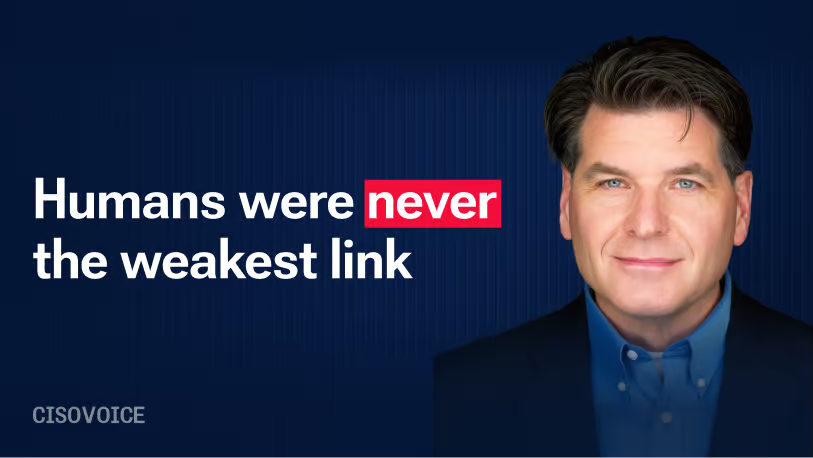
The belief that the human is the weakest link is the most repeated line in the cybersecurity industry, and I think it’s both wrong and corrosive. When a phishing email leads to a breach, the human clicking on it wasn’t the failure, the failure was an architecture where one click by one person could be catastrophic. We built systems where a single credential grants standing access to everything, blamed the user for guarding it imperfectly and then spent twenty years trying to train our way out of a design flaw.
The evidence is in what actually works. Phishing-resistant authentication such as passkeys and FIDO2 security keys didn’t make users smarter, they made the phishing attack architecturally irrelevant. You cannot be tricked into giving up a credential that can’t be given up. The same logic applies with least privilege and zero-knowledge design: the goal is to make human error survivable, not to make humans errorless.
The belief I’d challenge is that awareness training is a primary control when it’s a supporting control at best. If your security model depends on every employee making the right call every time under pressure, your security model is the weak link, not your people. We must design for fallible humans, because that’s the only kind there are.
Q. Finally, what advice would you give to fellow CISOs and security leaders?
I’d offer security leaders a few pieces of advice that I learned the hard way.
Learn the business better than the business expects you to. The CISOs who struggle are the ones who show up as the department of no with a technical vocabulary. The ones who succeed can sit in a revenue conversation, a product roadmap review or a board meeting, and translate risk into terms that drive decisions. Your technical depth gets you into the room, however, business fluency is what will get you invited back.
Assume compromise and build for resilience. The question isn’t whether you’ll have an incident, it’s whether the incident is a bad Tuesday or an existential event. Architecture decisions determine that answer years in advance through segmentation, ephemeral privilege, credentials that can’t be harvested at scale and backups you’ve actually tested. Spend your political capital on the boring structural things, because those are what save you.
Tell the truth, especially upward. The temptation to shade assessments green is constant, and every leader who gives in to it is borrowing against a future incident at a terrible interest rate. Your value to a CEO and a board is that you’re the person whose picture of reality they can trust. Guard that above everything.
Finally, take care of your people and yourself. Working in cybersecurity is a marathon run at sprint pace, and burnout is the quiet epidemic in our field. The team that responds well to a 2 a.m. incident is a team you didn’t grind into dust during the quiet months. Sustainable intensity beats heroics every time.