This year, fears of a vulnerability apocalypse have dominated security leaders’ attention.
In April, Anthropic unveiled Claude Mythos, a model it held back from public release over its ability to find and exploit software flaws, leading to months of speculation about an era of AI agents crashing the internet by exploiting thousands of previously unknown software flaws.
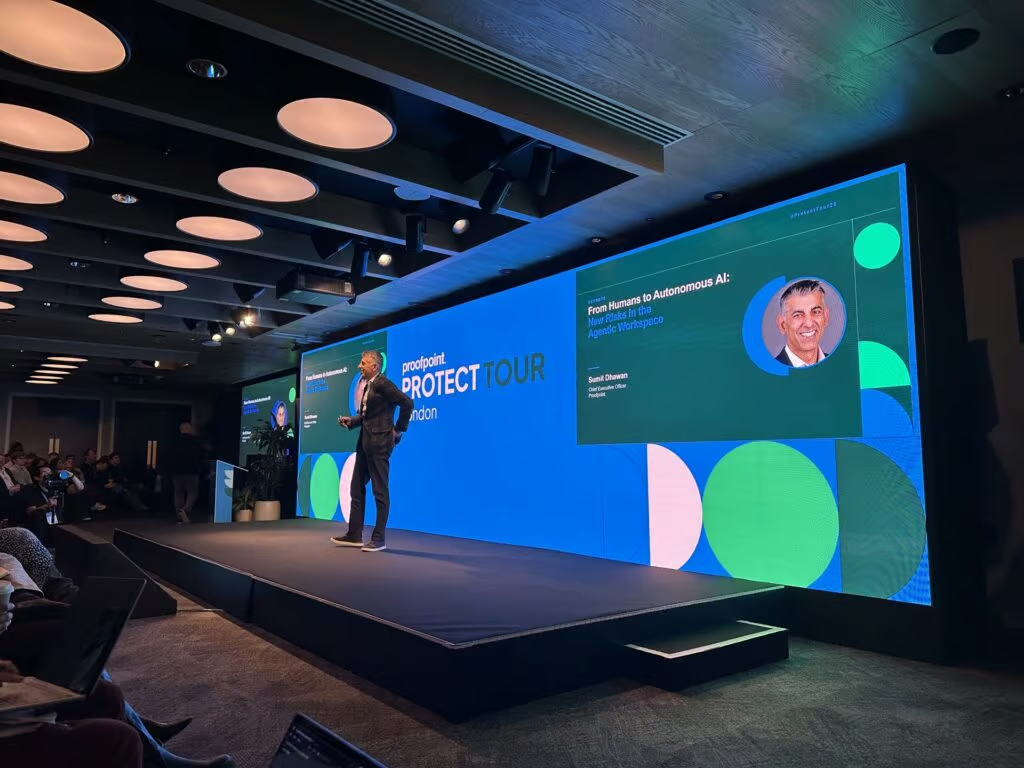
Proofpoint CEO Sumit Dhawan told CISO Voice that the security leaders he speaks to say their heads are spinning and that “80, 90% of their energy” is going on vulnerability management programs.
“That’s not a winning formula,” he argues. Because of compensating controls, many vulnerabilities may never be exploited even if they are found. So, security teams need a program that prioritizes vulnerabilities, while also heavily investing in other defenses.
In other words, vulnerability management is just one piece of the cybersecurity puzzle when it comes to AI.
AI identities are changing
Identity and access management was built for people using applications. Single sign-on gave each employee one primary identity, which connected to applications such as Salesforce, SAP and Zoom.
Agents break this traditional identity model, Dhawan explains. An agent built in Salesforce or on Amazon comes with its own identity on that platform. Agents are created and destroyed constantly, so it makes little sense to run them through a provisioning system, and many reach data directly, without clicking through an application’s workflows at all.
This means that AI agents hold their own identities and broad access to company data, often without the security team knowing they exist.
Unfortunately, identity controls built for humans do not fit neatly onto AI agents. For example, it makes no sense to give agents access by territory, region, or account, as companies do for staff.
“They need more granular controls,” Dhawan argues. “Should this agent have access to confidential information? Should they ever have access to invoice information? Should they ever have access to information that’s about an M&A project?”
Agents also behave differently from both humans and older rules engines; they keep assessing everything they can access to do the job they were given, and the more they are asked to do, the more they reach for. An employee may technically have access to details of an acquisition their company is planning, but would never find them. “Until you ask ChatGPT,” Dhawan says.
Companies don’t know how many agents they have
The scale is already large. Proofpoint’s latest European threat research identified more than 188,000 AI-enabled applications connected through authentication and OAuth frameworks.
Dhawan said that when Proofpoint asks customers how many agents they have, they often point to a policy requiring every new agent to go through a governance committee. Then Proofpoint runs its discovery tool. “They are orders of magnitude wrong,” he said, adding that counts are often out by around 100 times.
Often, staff do not set out to build an agent at all. They ask an AI tool to automate a task, and it creates agents in the background. Some companies assign each agent a human manager, so the agent inherits that person’s permissions. Dhawan said “that’s not a bad organizational framework,” but it does not remove the need to get the person’s own data permissions right.
Increasingly, agents are also given permissions separate from human identities altogether, creating an entirely new challenge for security leaders to manage their permissions and lifecycles.

What CISOs should do
Security teams need to know which agents exist and who manages them, make sure each agent can reach only the data it needs, and block activity beyond what the agent was designed to do, Dhawan says.
That does not mean shutting all access down on day one. Security teams should start from the exposure they find, then work with business owners to set permissions that make business sense.
Proofpoint is building these data-level controls into its own platform, and is in the process of acquiring data security firm Varonis in a $6.3 billion deal. Dhawan said he expects the acquisition to close going into 2027.
Dhawan also recommended that teams prioritize the flaws that matter in their environment while building what he called “layers of defense” against deception and misconfiguration.
He said CISOs should agree a realistic program with the board, so the security team is judged on how it prioritizes and responds rather than on every new headline.
And he said “rotating people between those two jobs is going to be critical”, referring to teams that chase incidents and teams that build proactive defenses.