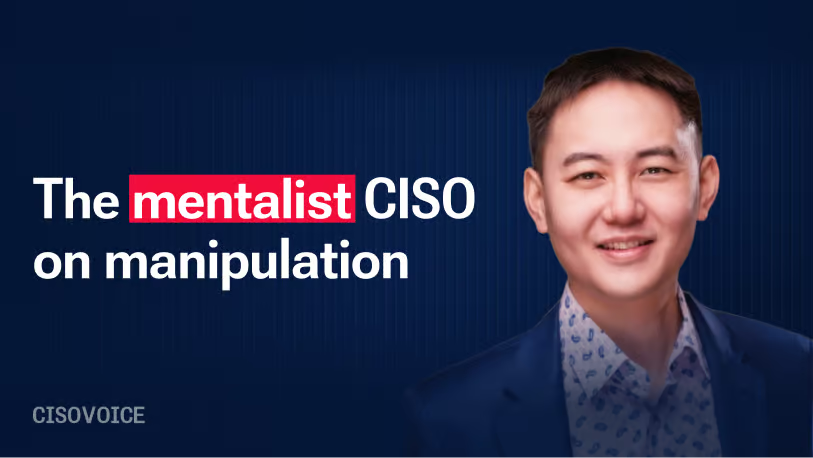
“The most sophisticated attack is not always the one that breaks the technology. Sometimes it is the one that understands people well enough to persuade them to open the door,” says Gary S. Chan, Security Mentalist.
We spoke with Gary S. Chan, professional mentalist and SSM Health CISO, on why the skills that decide a security program are the ones nobody tests for, and what that means for newcomers to the role.
Chan is an MIT graduate with a degree in electrical engineering and computer science, whose habit of taking things apart to see how they really work goes back to childhood. He is trained in mediation, interrogation, and negotiation, which he has since blended with his interest in magic and mentalism.
Chan is now the System Vice President and CISO at SSM Health, a multi-state healthcare system, and also the creator of Security Mentalism, which teaches social engineering by making it a performance.
What a mentalist knows that a firewall doesn’t
A successful attack often requires no technical skill at all. Something like a phishing email, a fake invoice, a concerning text message, or a voice-clone of your boss doesn’t need a vulnerability to gain access, it only needs to be convincing enough to persuade you to act.
Chan explains that attackers will use your trust and fear against you, utilizing false urgency, authority, curiosity, and familiarity to get you to act without challenging the situation. He describes mentalism as working with the same raw material: “attention, perception, trust, influence, and the decisions people make when they are rushed or distracted.”
Instead of simply spouting warnings about the dangers of social engineering, Chan offers a demonstration, and then a deconstruction, of how and why it works. “I show them how attention, perception, and influence can affect what they notice, what they believe, and how they make decisions.”
The goal isn’t to catch people out. It’s to leave them with an understanding, beyond a theoretical one, of how even an intelligent, switched-on person who is aware that danger is coming might be redirected and distracted enough to be influenced. That way next time an unusual request lands in front of them, they will be better prepared to question it.
That thinking shaped Chan’s approach to the mandatory training at SSM Health. To avoid the usual mindless clicking through screens or, worse, employees leaving the training playing in the background while they carry out other tasks, his team turned the training into a magic show. In it they would show someone being deceived, then take the deception apart to understand what the attackers did, what made the request believable, and at what point the person should have spotted the red flag.
Employees talked about the training afterwards, which was the point, because a conversation the next day is worth more than a good completion rate. Some even sent Chan Christmas cards to thank him for it. “That is not a normal reaction to mandatory security awareness training.”
Securing what you don’t control
Chan came into SSM Health from outside of the healthcare sector, and the environment required a change to how he approached security.
“The healthcare industry often moves more slowly and more conservatively than other industries, and that is not necessarily a bad thing. There are many regulations. More importantly, people’s lives are involved.”
He flips the common line in security, as it simply cannot apply in healthcare. “You can’t move fast and break things because people could die.” It’s always important to break out of the business bubble and remember what’s at stake.
In other industries responding to a breach could be locking something down or taking the system offline until there is better understanding of the situation. Healthcare doesn’t have that luxury. Clinicians will still need to have access to patient information to provide vital healthcare.
“You can do a good job securing your own environment and still have a serious problem because of something outside of your walls.” Another major consideration for Chan is the fact that in the event of a breach or attack the failure often comes from somewhere he cannot control or even oversee. His three examples were:
- A critical vendor being attacked, with the resulting disruption reaching everyone who depends on it (as with the Change Healthcare breach)
- A piece of open-source software is buried inside of other products, but turns out to have a major vulnerability which needs to be found before it can be fixed (as with Log4j)
- A security product ships a bad update which then takes down the machines it was there to protect (as with the CrowdStrike outage)
The first two points refer to outside threats, but the third comes from the very thing you put in place to protect you. “The tool you are relying on to protect you can also create a major operational problem if something goes wrong.” The defenses, in other words, are one more thing that needs to be monitored.
A questionnaire before you sign the contract isn’t third-party risk management on its own. You need to know what your organization depends on, how much it matters, what happens if it were to stop, and what to do if it does, because “in healthcare, that can quickly become a patient-care issue, not just an IT issue.”
Leading when the honest answer is that nobody knows
When asked what was keeping him up at night, Chan said it was how many directions the uncertainty around AI is coming from, all at once.
AI is a tool your employees are using, your vendors are building into their products (sometimes without the buyer even realizing) and then there are attackers, who are utilizing it to their full advantage. Meanwhile boards are expecting a strategy, legal wants to know what’s permitted and what isn’t, and security teams are trying to cover every base at once.
Faced with all that, the instinct may be to run the existing playbook, but quicker, more urgently. Chan warns that speed is not what’s missing: “That is like asking for faster horses when what you really need is a car. The problem is that nobody knows exactly what the car looks like yet.”
He is skeptical of those who claim otherwise. “There are also a lot of cybersecurity startups saying they have solved the AI security problem. They have not.” Since the rules for AI are still being set, organizations can find themselves caught between the risk of missing opportunities and the risk of moving too fast and being sued down the line.
This leaves CISOs in a predicament: they are being asked for the answers, but often there just isn’t one yet. Chan’s position on this issue is that CISOs should be honest and own up when they don’t know something. “I need to be comfortable saying, ‘We don’t know,’ while still retaining trust and helping the organization decide what to do next.”
He sees the responsibility shifting on the second front. “The role is also becoming less about personally owning every cyber risk and more about making sure the right people own the right risks.” And since prevention will never be complete, more of the job becomes resilience, which in a hospital means continuing to care for patients while something is broken.
A leadership job first
Getting the right people to own specific risks starts with persuading them it’s their responsibility. This is why Chan asserts that “as a CISO, you are constantly selling.”
He’s also realistic about what he’s selling against. “Nobody really wants to spend more money on cybersecurity. Nobody wants one more thing to do. People have deadlines. They have customers. They have budgets.” So, the pitch cannot be just a big list of vulnerabilities, all marked URGENT. Consider the CFO weighing up financial exposure, the operations leader looking at whether a control is likely to slow production, and front-line staff thinking about the effect on customer service. The big task is determining what each person you speak to is personally focused on, then explaining why security issues matter to them.
“If you cannot explain a security issue to a non-technical executive, then you probably have not made it clear enough yourself.”
Chan also talks about the power of your reputation as a CISO, and how being known as a good listener can get you invited into conversations earlier. Getting in the door means being a part of the conversation, not just receiving updates after the fact. “I am in the room while an idea is still being formed instead of getting a call after the decision has already been made.”
“It is not about performing a trick to get someone to agree with me. It is about building relationships and being useful before there is a problem.” His advice to anyone taking the job for the first time follows from that. “It is a leadership job first and a security job second.”
According to Chan, “[t]here is no single personality type that makes a good CISO.” For him, what set him apart was mediation, negotiation, and a deck of cards. For someone else it might be writing, teaching, mentoring, or simply being very good at listening.
What all those avenues share is that, in the end, they are about serving the same purpose, which is getting a room full of people to take on board what you say. The CISOs who can make that happen will be the ones people call for input when decisions are being made, not after.
For more information on Gary S. Chan and Security Mentalist, check out his website.