
A China-aligned threat actor group spent months impersonating AI experts in multiple credential phishing campaigns to spy on high-level AI policy discussions.
The previously unreported group, tracked by Proofpoint as TA419, impersonated several well-known AI policymakers and researchers, including Lynne Edwards Parker, a former member of the White House Office of Science and Technology Policy leadership team.
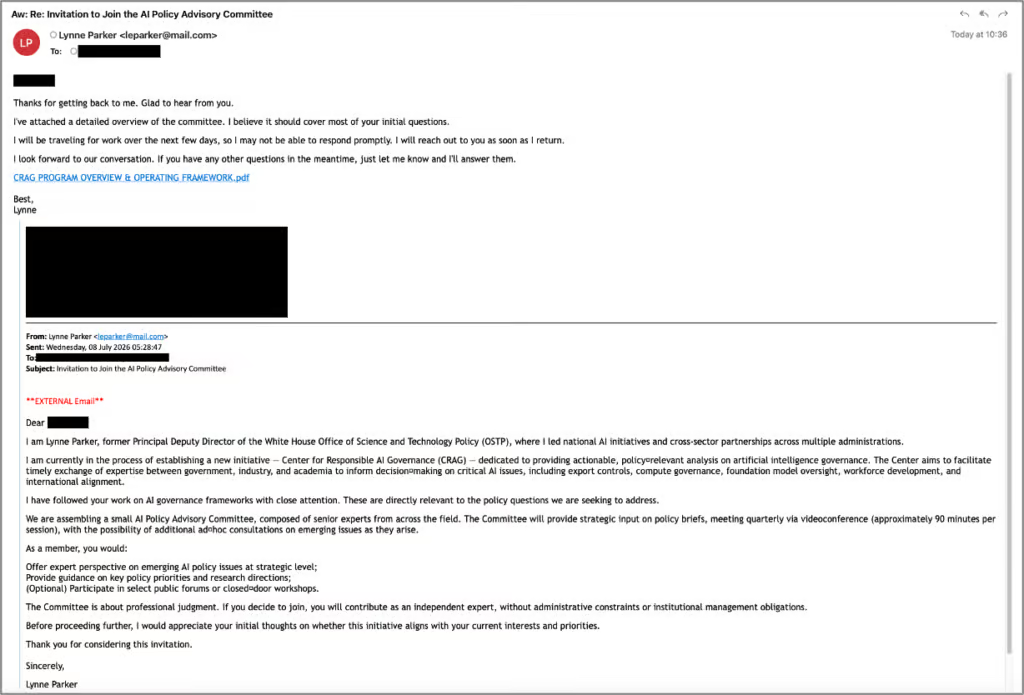
The impersonation attempt sent by TA419: Proofpoint
TA419 is a China-aligned, espionage-motivated threat actor that specializes in credential phishing. Proofpoint has tracked the group targeting individuals at US- and Japan-based think tanks, defense contractors, universities and law firms since at least April 2025.
“This activity likely supports wider Chinese intelligence objectives to better understand ongoing developments within the US AI policy and regulatory landscape,” wrote Proofpoint threat researcher Mark Kelly.
The phishing campaign began with TA419 inviting AI experts to join an AI Policy Advisory Committee via email. If the target users replied, the group followed up with a malicious URL which took users to a fake OneDrive phishing page designed to steal the users’ passwords and MFA tokens.

The phishing page TA419 tricked users into visiting: Proofpoint
The group used an open-source ‘browser-in-the-browser’ phishing kit which injects a malicious overlay onto proxied pages. The threat group extended this kit with custom capabilities that track the user’s progress through Microsoft’s user authentication process.
To a user logs in, it looks like a successful sign-in attempt. But the hackers are able to obtain passwords, MFA codes and session cookies. Proofpoint did not say whether any of the attempts succeeded.
“It’s disheartening to see bad actors exploit professional relationships and trust to deceive others. Protecting America’s leadership in AI also means protecting the people and institutions doing the work and understanding how those relationships can be targeted,” Lynne Parker, who was impersonated in this campaign, wrote on LinkedIn.
Chinese activity targeting AI leaders
The TA419 campaign reflects wider Chinese objectives to spy on Western-allied defense, national security and energy leaders.
Just this week, the UK’s MI5 Intelligence service issued a rare public warning that China’s intelligence service had set up a front company to fund UK research and conduct espionage on UK technical capabilities. Over 100 academics in the UK had contributed to these China-funded research projects.
TA419 will “likely continue targeting think tanks and policy experts working on technologies, and in geographies, of particular interest to the Chinese government,” Proofpoint wrote.
Proofpoint urged organizations who could be impacted to roll out phishing-resistant authentication methods, like passkeys, and recommended verifying unsolicited outreach before responding via email.